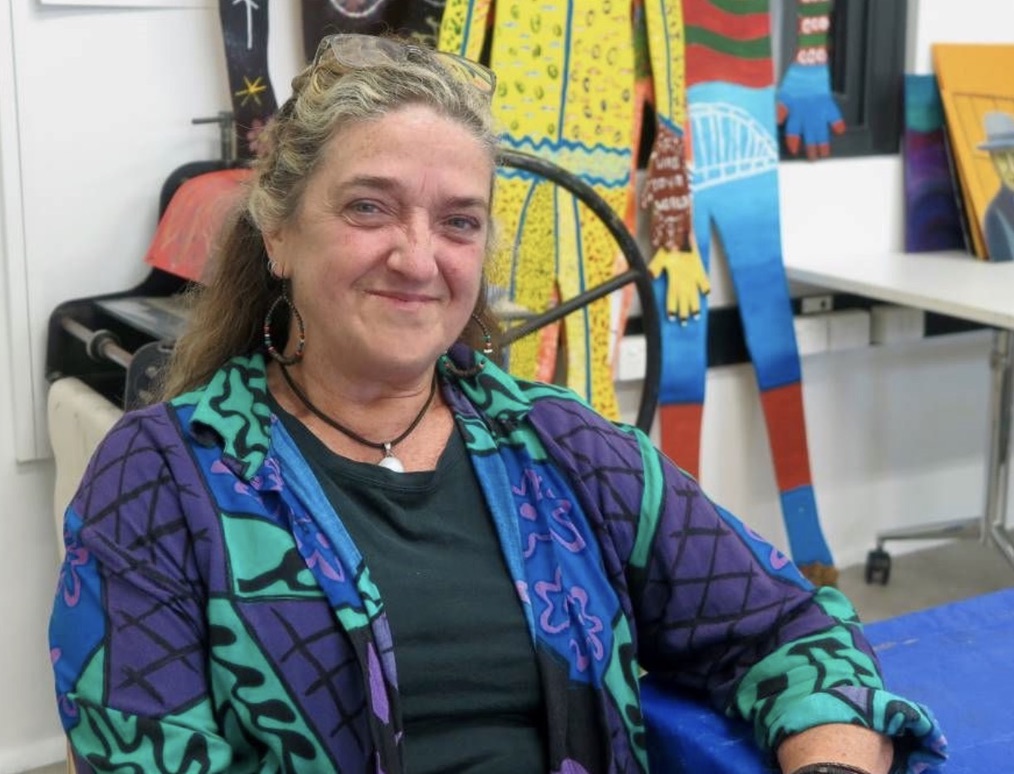
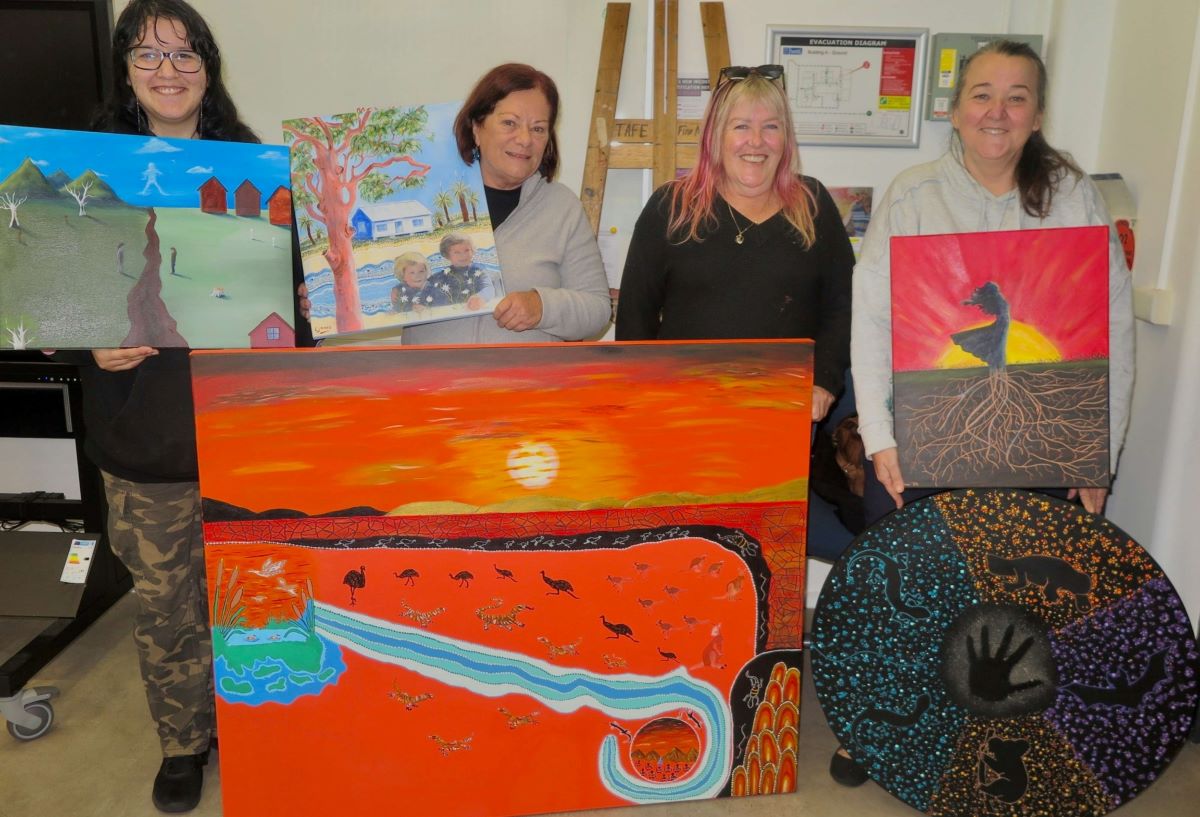
Art, community and connection. Some of the students proudly displaying their paintings at Blue Mountains TAFE, Katoomba. From left to right: Tori Christianson, Leanne Jones, Maree O’Brien and Ginni Christianson.“It’s a big chatfest,” says teacher, Leanne Tobin. (Photo: Linda Moon)
Story and photos by Linda Moon
Artists with an Indigenous heritage are telling their stories and finding a voice through a certificate course in Aboriginal and Torres Strait Islander Cultural Arts at Blue Mountains TAFE.
The offering of a Certificate 2 and 3 in Aboriginal and Torres Strait Cultural Arts is empowering ATSI students to connect to their cultural histories. While developing art skills and techniques they convey personal stories that explore the often untold truth of Australia’s past.
People come from as far away as Portland, Kurrajong and Summer Hill to attend Leanne Tobin’s class.
For the students the class offers much more than artistic skills and creative expression. They gain social connection and the ability to talk about their life experiences within an accepting environment. For this art class, the common bond is being descended from Indigenous people and what that brings.
Dharug community artist and cultural educator, Leanne Tobin, works alongside Ilona Bruckard, another Aboriginal Art teacher and together they encourage the students to tell their own personal journeys. “Sometimes they do portraits. It can be emotional. There’s lots of tears,” she shares.
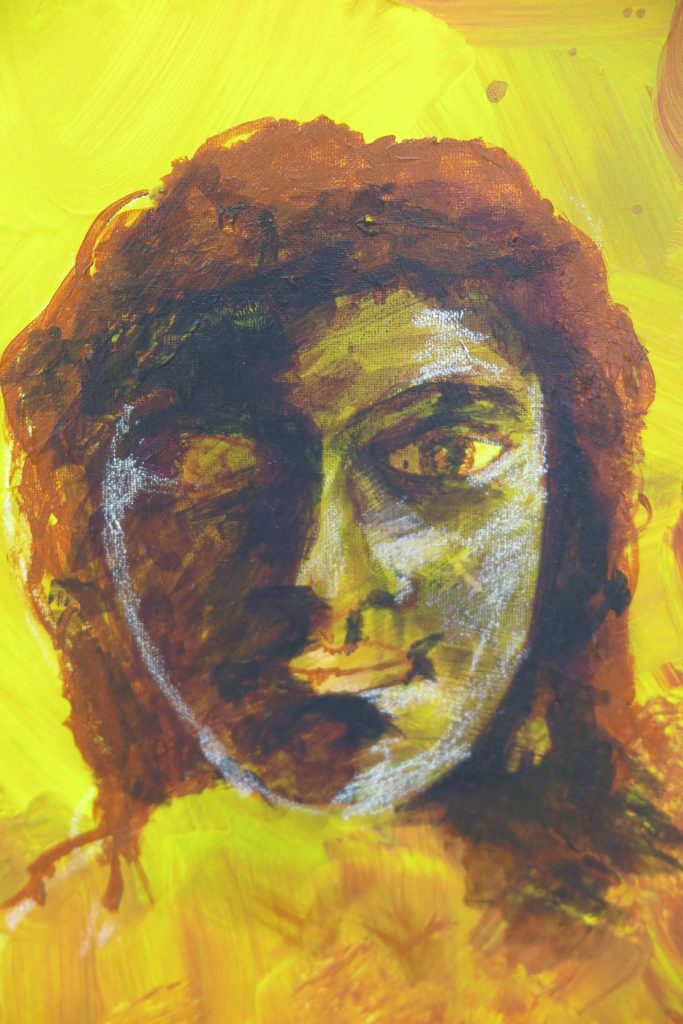
An artwork ‘in progress’ by B Hardy resulting from the course. “Acceptance is healing,” says teacher Leanne Tobin. (Photo: Linda Moon)
Power in authenticity and acceptance
Student, artist and mother, Leanne Jones, values the class as a place where she can be authentic. Jones has Dharug and Wiradjuri ancestry but that fact was kept hidden from her and her sister. She travels all the way from the Hawkesbury to attend the class. “You have to be yourself,” she says. “Everyone in this class has a story. We get to say who we are, why we’re here.”
At school Jones was kicked out of the classroom for questioning a history lesson on the discovery of Australia (by Captain Cook). “I said, ’no, sir, there were already people there’.” She recalls three children from the Stolen Generation at her school. “You could tell,” she says. But, back then, parents didn’t talk about being Aboriginal.
Dinawan Ngarraarry [Emu Hunt] by Indigenous artist and course participant Leanne Jones. Winner of the 2022/23 Blacktown City Art Prize (Indigenous art category) (Photo: TAFE NSW)
“It’s a healing class.” – Leanne Tobin
Healing intergenerational trauma through community art
The course is only open to people from Aboriginal and Torres Strait Islander backgrounds. As Tobin explains, this helps ensure participants feel culturally safe. “It’s a place where people can come and not be judged; a safe, cultural space.”
Many in the class have suffered from the impacts of what happened to their ancestors. The heart-wrenching injustices they describe seem inconceivable today but the shadows of those times remain. “There’s a lot of trauma in this class,” Tobin says. “Everyone has got some kind of story. Sometimes they share stuff they haven’t told anyone before. It’s a beautiful thing to see people feeling safe to tell their truth. All their stories form a collective narrative of what happened here on Country.”
The stories shared reflect what Tobin refers to as “first contact times where cultures collided”. Stories of disconnection from family, Country, culture, as well as shaming, suppression and secrecy, are common themes.
Tobin’s classes include a mother and daughter and also a father and daughter team. The course offers an enjoyable and constructive way they can experience intergenerational healing and learn about their family, Tobin says.
Tobin, who has also worked in jails with Koori offenders, says that this disconnection from family, culture and Country is often the underlying cause of Indigenous stress and trauma. Working in jails was frequently about filling in the gaps of questions, such as “why did my mother abandon me?”
“My passion for art comes from the need to tell stories that are untold.” Community artist and cultural educator, Leanne Tobin, at Blue Mountains TAFE, Katoomba. (Photo: Linda Moon)
Yarramundi’s descendent continuing the work
Tobin, a descendent of the Dharug people of Western Sydney, has a fascinating history of her own.
Her mother was born in a terrace house in Harris Street on the banks of the Parramatta River in 1933 where the Albion Hotel now stands. Many Dharug babies were born here because the White Australia Policy (of the time) restricted Aboriginal women from having their babies in hospital.
As a teenager growing up in Emu Plains she didn’t know anything about her family background. Her grandmother had kept their ancestry a secret from her mother.
In adulthood she discovered that her great grandfather x 4, was the distinguished tribal Elder and ‘Karadji’ (medicine man), Yarramundi – after whom the township Yarramundi was named. His daughter was Maria Lock – one of the first stolen generations, being the first enrolment at the Parramatta Native Institution set up by Governor Macquarie in 1814. Maria graduated fully literate and married illiterate convict carpenter Joseph Lock on the 26th January in 1824 at St John’s Church Parramatta in what was to be the first official interracial marriage in Australia. Maria was also a talented student who topped 100 European and 20 Aboriginal students in a state-wide academic test.
Tobin, a practising artist, has also distinguished herself. In 2011, she won the Parliament of NSW Aboriginal Art Prize for her painting Defending Country.
Held once a week for four hours (across two years), the certificate level course is something people can fit into their lives, Tobin says.
The students study and practise painting, printmaking, drawing, digital art, ceramics, sculpture and other visual art techniques. “We often have critique sessions that allow the students to see the various stages of development each artwork goes through and also opens discussion between the students on various techniques, challenges and stories,” she says. Each term a new unit begins exploring various media and also includes learning about various aspects of the cultural art industry, such as copyright and protocols within community.
The cultural component – recognising and identifying culture – is a core focus.
Connecting to Aboriginal culture also switches participants onto Caring for Country, Tobin says. “Everyone who resides on Country, now needs to take on that custodianship. We all need clean air, clean water, clean food.”
This story has been produced as part of a Bioregional Collaboration for Planetary Health and is supported by the Disaster Risk Reduction Fund (DRRF). The DRRF is jointly funded by the Australian and New South Wales governments.
Join Andris Heks, Yogic Psychotherapist, winner Best Actor, Blue Mountains, for his workshop to laugh as you never laughed before, as part of a movement to globalise people-bonding cheerfulness through kookaburra laughter contagion as an antidote to distressing world divisiveness.
Purchase your ticket here: https://events.humanitix.com/kookaburra-laughter-workshop
View the trailer and the GoFundMe page here: https://www.gofundme.com/f/globalise-unconditional-love-through-kookaburra-laughter
Key event information: - When? 10:15AM - 2:30PM, Sunday 4 October 2026 (1st day of Daylight Saving - 1 hour forward) - Where? Blue Mountains Planetary Health Centre, 33-39 Acacia St, Katoomba, NSW, 2780 - Fee? $60 or what you can afford - Note: please bring your own lunch
What to expect: - Learn how to stay cheerful for good - Learning the funny, human emulated, communal kookaburra laughter and meditation - How communal kookaburra laughter promotes bonding even amongst strangers - The awesome native treasure of the laughing kookaburra phenomenon - Why Kookaburra Yoga is the ‘most excellent of Yogas` - How communal kookaburra laughter contagion boosts the subtle and gross national product - How you could contribute to the kookaburra laughter contagion
This event is supported by Blue Mountains Planetary Health.
Purchase your ticket here: https://events.humanitix.com/kookaburra-laughter-workshop...
Come along to the Planetary Health Centre this Saturday for the next Skill Share Saturdays event!
This weekend`s agenda:
8:30AM - 10AM | Learn how to use your sewing machine class with Sherlie McMillan
8:30AM | Planetary Health Cafe open, serving Good Fat Pastry and Whisk and Pin
9AM - 10AM | Tai Chi and Qigong class with Virginia Field
10AM - 12PM | Learn how to grow WITH the Upper Blue Mountain permaculture workshop with Leni from Alchemy Farms
10AM - 3PM | Fashion Upcycling Workshop with Sherlie McMillan
10:30AM - 12PM | Learn to make focaccia from scratch with Laura Zucchetti (no experience needed)
1:30PM - 4:30PM | Planetary Health Bushcare with Karen Hising
For more information and to purchase a ticket, please visit the website: https://events.humanitix.com/skill-share-saturdays-at-the-planetary-health-centre...
Plate to Planet: Blue Mountains Food Security Fair 2026
📣HEADLINE SPEAKER📣
Our headline speaker is Julian Cribb AM – a renowned Australian science writer, journalist and author who has spent more than 50 years communicating science, agriculture, climate and global sustainability issues. He is the author of several influential books, including The Coming Famine (2010), Food or War (2019) and How to Fix a Broken Planet (2023), which explore the future of food systems, planetary health and humanity`s long-term survival.
He is widely recognised as one of Australia`s leading voices on global food security and sustainable development.
To register for his talk, and view the rest of the program, visit the website: https://events.humanitix.com/blue-mountains-2026-food-security-fair...
At our next Skill Share Saturdays event on Saturday 5th September, join Laura Zucchetti at 10:30am to learn how to make focaccia from scratch!
Come along for a 90 min class where you`ll mix, rest and stretch your own focaccia dough from start to finish, guided every step of the way. You’ll take home your dough to bake on the day in your own oven.
Sign up to this session, and view the other offerings on the day via this link: https://events.humanitix.com/skill-share-saturdays-at-the-planetary-health-centre...
Plate to Planet: Blue Mountains Food Security Fair 2026
We are pleased to announce that the program and registration for Plate to Planet: Blue Mountains Food Security Fair 2026 is now live!
Follow this link to view the program and register your place: https://events.humanitix.com/blue-mountains-2026-food-security-fair
Key information:
When? Saturday 10 October, 9AM - 4PM
Where? Blue Mountains Planetary Health Centre, Katoomba
Who is it for? Families, gardeners, enthusiasts, community groups and businesses, anyone looking to learn about how to be more resilient through local and sustainable food systems.
What to expect? Talks, workshops, demos, market stalls, family activities, music, food
Is there a cost? Entry to the Fair and Markets is free. Talks and workshops are ticketed (both free and paid) and have limited capacity, so please register in advance.
Program highlights:
🌏Headline talk: The age of renewable Food – Julian Cribb AM 🎋Wild edibles foraging workshops – Diego Bonetto, Eat More Weeds 🏞️The importance of bioregions in uncertain times – Rowe Morrow, Permaculture Matters 🥒Home canning and food preservation workshop – Kirsty Berté, Permaculture Hawkesbury Valley 🏡Designing your own Permaculture Property – Leni Nyssen, Alchemy Farms 🍃Utilising what’s in front of you – Uncle Lex, The Ganya Shed 🪱How to worm farm - BMCC 🎸Live music by Olivia Dustmann 🌾Community crop and seed swap
Tickets are limited so please register your place now: https://events.humanitix.com/blue-mountains-2026-food-security-fair
We are also seeking stallholders for the event. If you are a grower, retailer, community organisation or business that would like to get involved, please reach out to [email protected]!...
Thank you to everyone that joined us at the Planetary Health Centre on Saturday for the first of our Skill Share Saturdays program!
The Centre was a hive of activity all day, and we heard from @alchemyfarms_permaculture, the @ediblegardentrailbluemountains team and Andy Mann. Also thanks to Sherlie McMillan from Greater Blue Mountains Rotary for teaching the Fashion Upcycling workshop, and Virginia Field for the Tai Chi and Qigong class.
The next event will be held on Saturday 1st August - you can register your place here: https://events.humanitix.com/skill-share-saturdays-at-the-planetary-health-centre
🖐Get involved!
Do you have a skill, program or interest that promotes planetary health that you`d be willing to share with members of the local community? We are looking for more workshop and session hosts for our future events.
Join us at the Planetary Health Centre in Katoomba on the first Saturday of every month for Skill Share Saturdays!
Our July program includes: - What to grow in a Blue Mountains climate - Eating for Earth - Tai Chi and Qigong - Fashion upcycling and clothing reuse workshop - How to get involved with the Edible Garden Trail
You are also welcome to bring any surplus seeds or produce for our Crop Swap, or wind down in the Planetary Health Cafe (until 2pm).
If you have a skill that you want to share, or any questions or queries, please contact [email protected]
Visit the website to view the full program of events and register your place.
Join Andy Mann, a 23 year old Lawson local, for their Eating for Earth session 🌏
Eating for Earth is a judgement-free plant-based educational workshop that all types of eaters are encouraged to attend. There will be a presentation about the environmental impact of diets, a discussion section, and best of all, food! The food will be fully plant-based.
Andy wants to help inform our passionate community about how we can better reduce dietary environmental impact.
The session will run from 11AM - 12PM on Saturday 4th July.
Other sessions include: - What to grow in a Blue Mountains Climate - Fashion Upcycling - Tai Chi and Qigong - Bushcare on the Planetary Health site - How to get involved with the Edible Garden Trail
To register your place, visit our website: https://events.humanitix.com/skill-share-saturdays-at-the-planetary-health-centre...
We’re excited to announce the second Blue Mountains Food Security Fair, taking place in Katoomba in October 2026.
This annual event will bring together growers, thinkers, makers, and community members to explore one of the most important challenges of our time: how we grow, share, and sustain food in a changing world.
Across the weekend, we’ll be exploring themes including: - Healthy soil and regenerative systems - Food and human health - Plant-based food futures - Home and community food resilience - Water-sensitive and climate-adapted growing - Indigenous food knowledge and systems - School food systems - Australia’s food procurement - Global food security challenges Expect a dynamic program of inspiring speakers, practical workshops, and hands-on experiences designed to leave you informed, empowered, and connected.
Key information Date: Weekend of 10th October 2026 Location: Blue Mountains Planetary Health Centre, Katoomba, NSW We’ll be announcing speakers and program details soon.
We are also inviting expressions of interest from individuals and organisations who would like to contribute to the program, host workshops, run a stall or partner with us.
Do you struggle making the most of your veggie garden all year round?
Join Leni from @alchemyfarms_permaculture on Saturday 4th July for her Permaculture Workshop: Learn how to grow WITH the Upper Blue Mountains seasons, rather than battling against them.
During the two-hour session, you`ll cover crop selection for different seasons, what to grow from seeds vs seedlings, frost and wind protection, and nurturing your soil with a seasonal cycle.
Register for this and other sessions as part of our Skill Share Saturdays program via this link: https://events.humanitix.com/skill-share-saturdays-at-the-planetary-health-centre...
From Saturday 4 July, we are opening up the Planetary Health Centre for our monthly Skill Share Saturdays program: https://events.humanitix.com/skill-share-saturdays-at-the-planetary-health-centre
Throughout each day, you can expect to find a variety of sessions focused on restoring the health of the planet, in terms of the environment, community and economy.
Sessions at the first event include:
- What to grow in a Blue Mountains climate - Plant-based eating - Tai Chi and Qigong - Fashion Upcycling and clothing reuse workshop
You are also welcome to bring any surplus seeds or produce for our Crop Swap, or wind down in the Planetary Health Cafe (until 2pm).
Visit the website to view the full program of events and register your place: https://events.humanitix.com/skill-share-saturdays-at-the-planetary-health-centre
Registrations essential.
We are also inviting expressions of interest from individuals and organisations who would like to contribute to the program - please reach out to [email protected] if you are interested!...
Linda Moon has lived in the upper Blue Mountains since childhood and is a freelance writer for Australian media. A qualified naturopath, permaculture designer, mother and former student of social work, her passion is building local community, gardening, mental, emotional, social, housing and environmental health – all of which are linked!
In Katoomba, a grassroots litter-picking group tackles rubbish before it reaches our water supply. Their story shows how local environmental action, fueled by community connection, can drive meaningful change for planetary health.
Support the Future of Solutions-Focused Neighbourhood News
![Dinwan Ngarraarry [Emu Hunt] by Indigenous artist and course participant Leanne Jones](https://www.katoombalocalnews.com/wp-content/uploads/2024/05/emu-hunt-leanne-tobin.jpg)