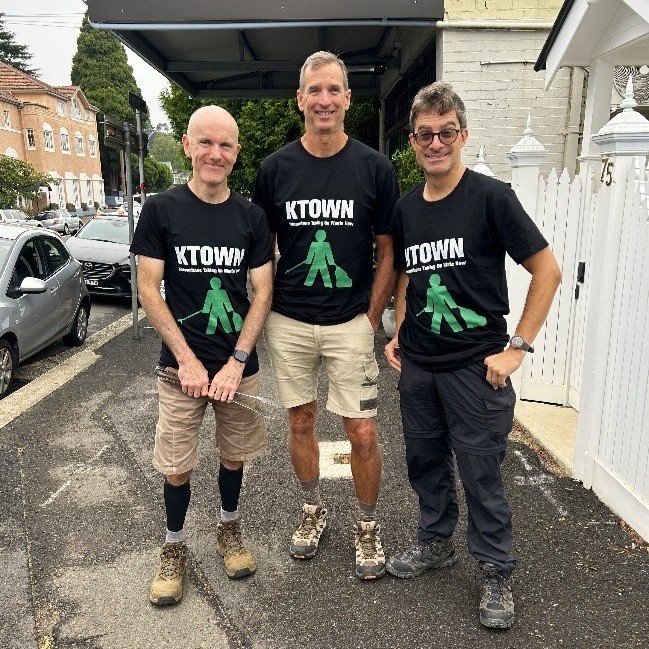
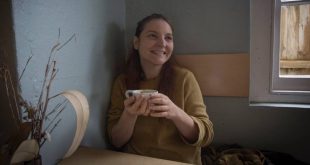
KTOWN’ers (L-R) Simon, Don & Adam, outside ‘the office’ Cassiopeia
In Katoomba, a grassroots litter-picking group tackles rubbish before it reaches our water supply. Their story shows how local environmental action, fueled by community connection, can drive meaningful change.
Key Points:
- One man’s simple decision to pick up litter in Katoomba grew into a small community group, demonstrating how individual actions can spark broader movements.
- The group observed that the NSW container deposit scheme reduced bottle and can litter by almost 50%, showing that the right incentives can effectively change people’s disposal habits.
- The Katoomba group exemplifies how local communities can take ownership of environmental challenges, with their work protecting both local ecosystems and broader water systems while building social connections.
On a wet afternoon in the Blue Mountains, rainwater surges down Katoomba’s streets, carrying scraps of plastic, takeaway cups, and stray fragments of paper. Left unchecked, the torrent would sweep through Katoomba Falls, down the Jamison Valley, and ultimately into Warragamba Dam—Sydney’s main water supply.
But on this day, the flood of waste is interrupted by a small act of care. A man in a “KTOWN” shirt crouches by the curb, pulling rubbish from the gutter with a pair of barbecue tongs. What he collects may seem insignificant—half a bag of plastic, a handful of cans—but each piece is one less hazard for wildlife, one less pollutant in the water system.
This is Katoomba’s ‘KTOWN’ litter-picking group – Katoombans Taking On Waste Now – a small, grassroots effort with an outsized impact.
A personal journey
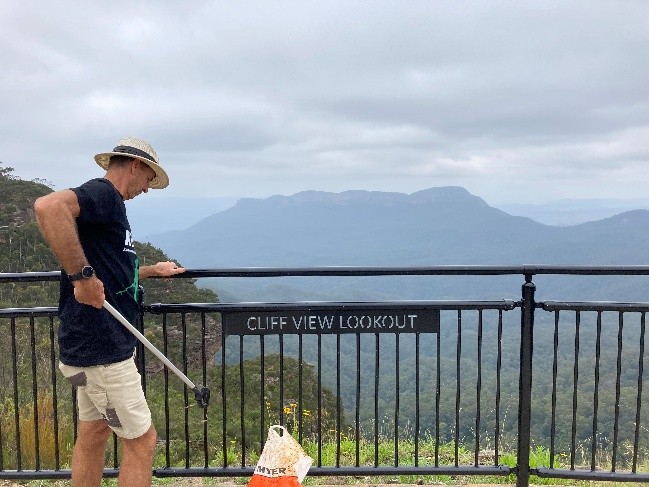
Lookout litter spoiling the view
The group’s origins are humble. Simon Day, a long-time bushwalker and Bushcare volunteer, moved to Katoomba in 2019, drawn by the pristine escarpments and World Heritage wilderness.
“I thought the litter problem would be less here than in Sydney,” he admits. “But it turns out rubbish is a universal phenomenon.”
His solution was simple: pick it up. With nothing more than a reusable bag and a pair of gloves, he began clearing litter from local tracks and streets. Soon after, fellow resident Don noticed him while walking his dog and struck up a conversation. Over a coffee with Don, Adam joined, and the Katoomba litter-picking group was born.
“It shows how one small action can spark a movement,” he says.
The practice of picking
The group’s “tool kit” is hardly high-tech—bags, gloves, and $10 grabbers from the hardware store. But the rewards are immediate.
“After just half an hour, you look down at the bag and realise how much has been stopped from going into the creek,” Simon reflects. “It’s a small effort, but it makes a big difference.”
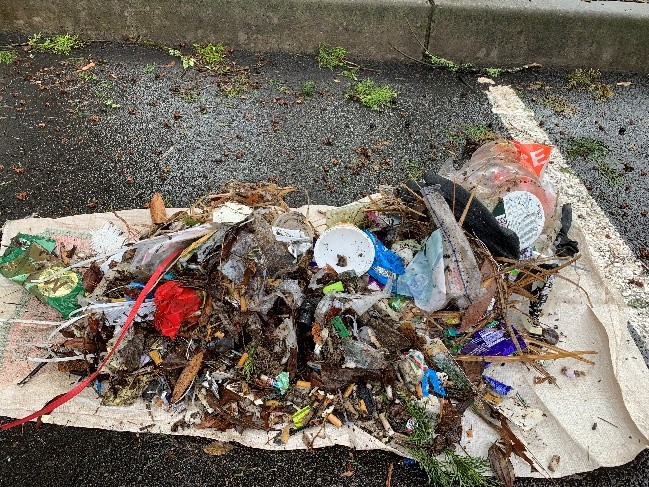
Litter collected near the Hydro Majestic Hotel in Medlow Bath
Their work focuses on “hot spots”: the heavily trafficked escarpment walks near Scenic World and Echo Point, rest areas along the highway, and picnic grounds such as Maple Grove, where rubbish piles up alarmingly fast.
The practice isn’t just about beautification. It’s about prevention. Each piece removed before the next rainstorm means fewer pollutants in creeks, valleys, and ultimately in Sydney’s drinking water.
Camaraderie and coffee
While the picking itself is important, the group has also discovered the quiet joy of camaraderie. They often meet at Cassiopeia Café in Katoomba, a cosy local spot where maps are spread out and decisions made about which “hot spots” to tackle that day. After a session of litter-picking, the group reconvenes at the café to debrief, swap stories, and share the small triumphs of the morning.
“It gives us a sense of belonging,” says Simon. “You’re not just cleaning up—you’re part of a little community that cares about this place.”
In that ritual of coffee, conversation, and connection, the work becomes more than environmental action. It becomes a social bond that sustains the effort.
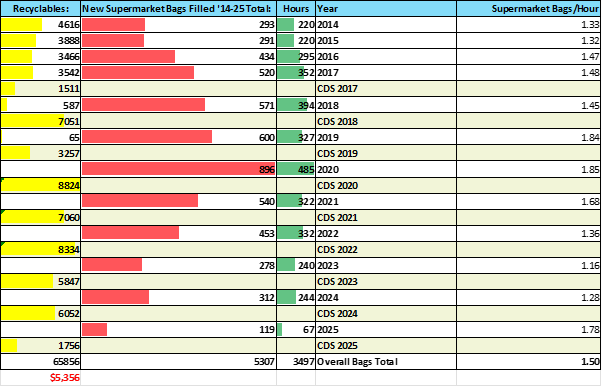
Simon’s ‘litter diary’. Note the $5,356 made from recycling drink containers through the Return and Earn scheme since 2014
“The frustrating part is that so much of this is preventable,” says Simon. “It’s not just about the plastic itself. It’s about behaviour—someone had it in their hand, and they let it go.”
The group documents what they see, submitting photos and reports through the Council’s customer service system.
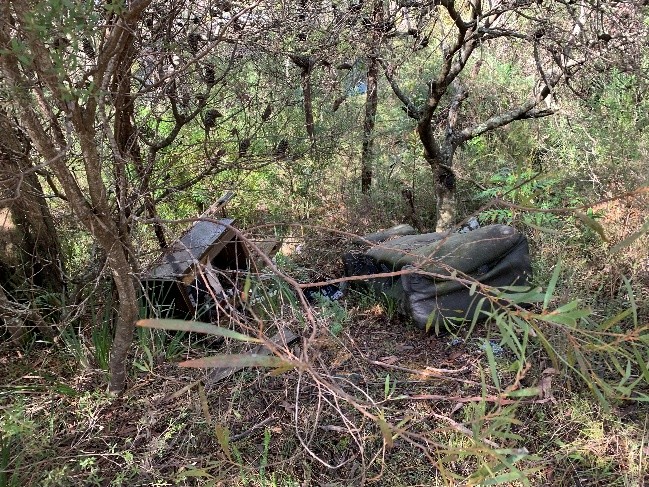
A dumped couch and TV, reported to Council for removal
Changing behaviour
The pickers are clear: real change will only come from shifting behaviour. And small incentives can help.
Since the introduction of the NSW container deposit scheme, they’ve observed almost a 50% reduction in bottles and cans littering local streets. “As soon as there was a monetary value attached, people stopped throwing them away. That shows what’s possible.”
But the group also believes in leading by example. Wearing their “K-Town” shirts while they work often sparks conversations with locals and visitors alike.
“People come up to us and say, ‘That’s a great idea,’” Simon explains. “It raises awareness just by being visible.”
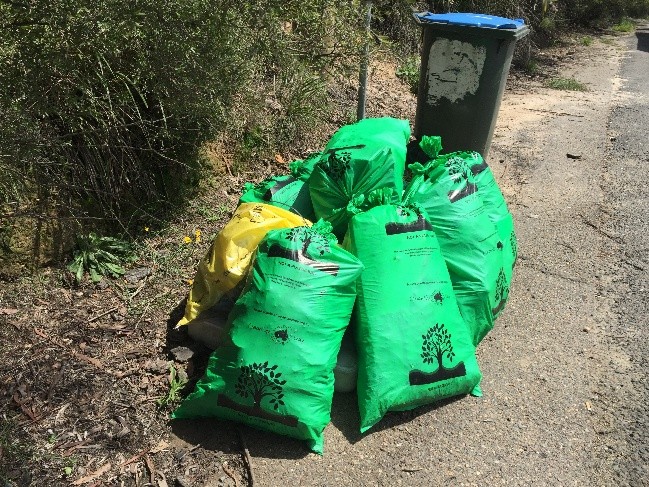
Bags of litter collected at a highway rest area in Katoomba
Beyond blame
It’s tempting to blame tourists for litter in the Blue Mountains, but the group’s experience suggests otherwise.
“Locals are just as responsible,” one says. “You see homeowners who don’t clear the gutter outside their house, or businesses who ignore the rubbish on their footpath. If we want visitors to respect this landscape, we have to show that we respect it ourselves.”
This ethos links directly to planetary health, the emerging field that connects human wellbeing with the health of natural systems. By keeping streets and creeks clean, the group isn’t just protecting wildlife—they’re safeguarding water quality, reducing plastic pollution, and fostering community pride.
Grassroots action for planetary health
Globally, efforts to tackle plastic pollution often stall at the policy level. The recent international plastics summit ended without consensus, despite the urgency of the problem. But grassroots action tells a different story.
“Rather than waiting for a top-down solution, we have to do something ourselves,” says Simon. “Change has to come from the ground up.”
This philosophy is echoed by planetary health advocates worldwide: local actions can scale into systemic change. Councils are the closest level of government to communities, and when residents and local authorities collaborate, they can build momentum that eventually reaches higher levels of governance.
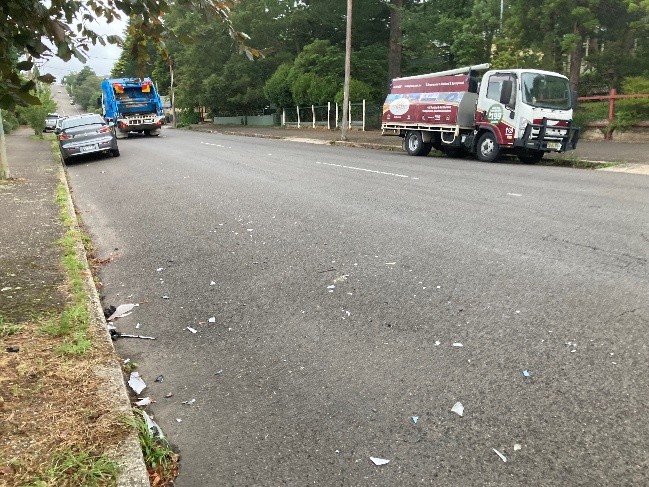
Vehicle crash debris on Katoomba Street, headed for our waterways
A fragile hope
The work is never finished. Within a week of clearing a site, new rubbish appears. But persistence is part of the point.
“It’s easy to imagine a dystopian future, like the film WALL·E, where we drown in our own waste,” says Simon. “But it’s just as possible to imagine a future where communities take ownership of their environment. Where every creek, every street, is valued as part of a living system.”
In Katoomba, that future is already taking shape—one bag of rubbish at a time, often with a cup of coffee waiting at Cassiopeia afterwards.
Planetary health, piece by piece
The litter-pickers of Katoomba don’t see themselves as heroes. They see themselves as neighbours, custodians, and ordinary people doing what needs to be done.
But in their persistence lies a profound lesson for planetary health: global challenges can be tackled from the ground up. Each act of care ripples outward—into the waterways, into the community, into the wider world.
The story of Katoomba’s litter-picking group is not about perfection. It is about participation. And it reminds us that protecting the planet doesn’t always start in parliaments or at summits. Sometimes, it starts with a pair of tongs, a reusable bag, and the decision to bend down and pick something up.
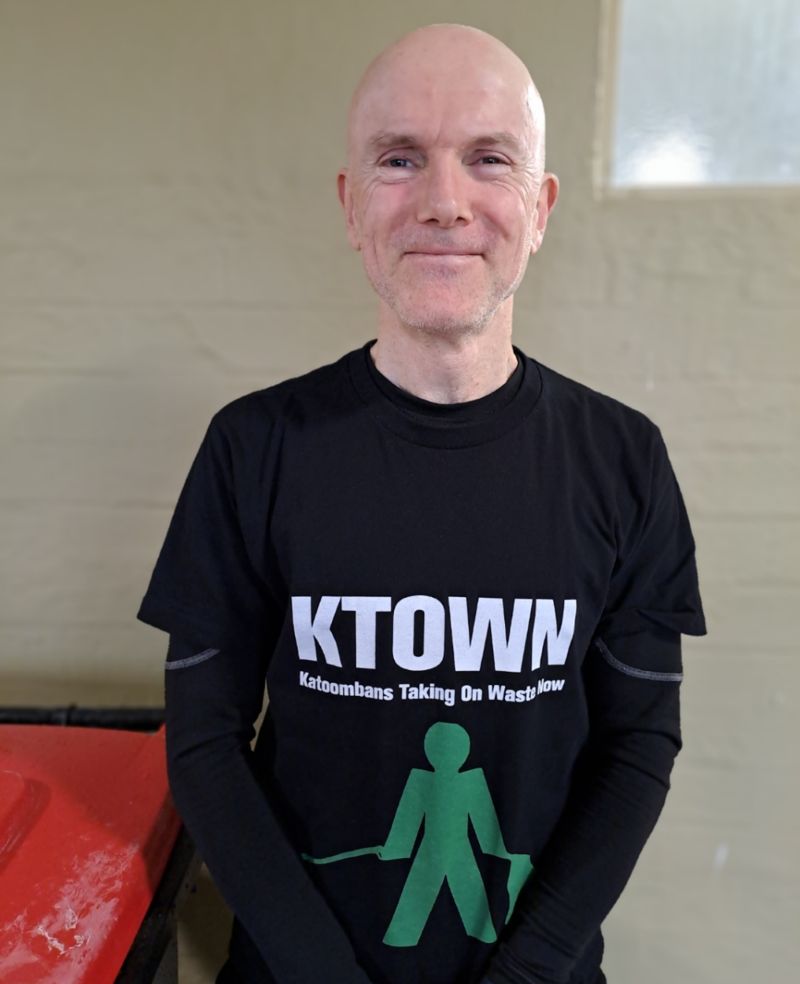
Simon Day, anti-litter hero and founder of KTOWN
Start your own litter picking group:
- Start small – All you need is a bag, gloves, and a pair of tongs or grabbers. Even 30 minutes of collecting makes a difference.
- Pick a patch – Focus on local “hot spots” where rubbish gathers—creeks, parks, rest areas, or streets with heavy foot traffic.
- Be visible – Wear a simple shirt or badge so people know what you’re doing. Visibility sparks conversations and inspires others. Check out Katoomba T-Shirts who make custom designs.
- Meet regularly – Choose a café or community spot to gather before and after picking. Sharing the experience builds camaraderie and keeps motivation high.
- Record and report – Take photos, track what you collect, and report bigger issues (broken bins, unsafe sites) to your local council.
- Celebrate the wins – Every bag of rubbish removed is a small victory—for your community, your waterways, and planetary health.
- Contact Simon for more ideas on 0478 455 528
More from around the region

bluemountainsplanetaryhealth
Sep 7

Join Andris Heks, Yogic Psychotherapist, winner Best Actor, Blue Mountains, for his workshop to laugh as you never laughed before, as part of a movement to globalise people-bonding cheerfulness through kookaburra laughter contagion as an antidote to distressing world divisiveness.
Purchase your ticket here: https://events.humanitix.com/kookaburra-laughter-workshop
View the trailer and the GoFundMe page here: https://www.gofundme.com/f/globalise-unconditional-love-through-kookaburra-laughter
Key event information:
- When? 10:15AM - 2:30PM, Sunday 4 October 2026 (1st day of Daylight Saving - 1 hour forward)
- Where? Blue Mountains Planetary Health Centre, 33-39 Acacia St, Katoomba, NSW, 2780
- Fee? $60 or what you can afford
- Note: please bring your own lunch
What to expect:
- Learn how to stay cheerful for good
- Learning the funny, human emulated, communal kookaburra laughter and meditation
- How communal kookaburra laughter promotes bonding even amongst strangers
- The awesome native treasure of the laughing kookaburra phenomenon
- Why Kookaburra Yoga is the ‘most excellent of Yogas`
- How communal kookaburra laughter contagion boosts the subtle and gross national product
- How you could contribute to the kookaburra laughter contagion
This event is supported by Blue Mountains Planetary Health.
Purchase your ticket here: https://events.humanitix.com/kookaburra-laughter-workshop
...
bluemountainsplanetaryhealth
Sep 2
Come along to the Planetary Health Centre this Saturday for the next Skill Share Saturdays event!
This weekend`s agenda:
8:30AM - 10AM | Learn how to use your sewing machine class with Sherlie McMillan
8:30AM | Planetary Health Cafe open, serving Good Fat Pastry and Whisk and Pin
9AM - 10AM | Tai Chi and Qigong class with Virginia Field
10AM - 12PM | Learn how to grow WITH the Upper Blue Mountain permaculture workshop with Leni from Alchemy Farms
10AM - 3PM | Fashion Upcycling Workshop with Sherlie McMillan
10:30AM - 12PM | Learn to make focaccia from scratch with Laura Zucchetti (no experience needed)
1:30PM - 4:30PM | Planetary Health Bushcare with Karen Hising
For more information and to purchase a ticket, please visit the website: https://events.humanitix.com/skill-share-saturdays-at-the-planetary-health-centre
...
bluemountainsplanetaryhealth
Aug 19
Does your business focus on sustainable produce, living or community?
We are seeking stallholders for our upcoming event ‘Plate to Planet: Blue Mountains Food Security Fair’, Saturday 10 October 2026.
This is an opportunity to promote your service, sell your products and engage with the community.
To find out more about being part of this event, please contact [email protected]
View the full event program here and register your place: https://events.humanitix.com/blue-mountains-2026-food-security-fair
...
bluemountainsplanetaryhealth
Aug 14
Plate to Planet: Blue Mountains Food Security Fair 2026
📣HEADLINE SPEAKER📣
Our headline speaker is Julian Cribb AM – a renowned Australian science writer, journalist and author who has spent more than 50 years communicating science, agriculture, climate and global sustainability issues. He is the author of several influential books, including The Coming Famine (2010), Food or War (2019) and How to Fix a Broken Planet (2023), which explore the future of food systems, planetary health and humanity`s long-term survival.
He is widely recognised as one of Australia`s leading voices on global food security and sustainable development.
To register for his talk, and view the rest of the program, visit the website: https://events.humanitix.com/blue-mountains-2026-food-security-fair
...
bluemountainsplanetaryhealth
Aug 7
At our next Skill Share Saturdays event on Saturday 5th September, join Laura Zucchetti at 10:30am to learn how to make focaccia from scratch!
Come along for a 90 min class where you`ll mix, rest and stretch your own focaccia dough from start to finish, guided every step of the way. You’ll take home your dough to bake on the day in your own oven.
Sign up to this session, and view the other offerings on the day via this link: https://events.humanitix.com/skill-share-saturdays-at-the-planetary-health-centre
...
bluemountainsplanetaryhealth
Aug 4
Plate to Planet: Blue Mountains Food Security Fair 2026
We are pleased to announce that the program and registration for Plate to Planet: Blue Mountains Food Security Fair 2026 is now live!
Follow this link to view the program and register your place: https://events.humanitix.com/blue-mountains-2026-food-security-fair
Key information:
When?
Saturday 10 October, 9AM - 4PM
Where?
Blue Mountains Planetary Health Centre, Katoomba
Who is it for?
Families, gardeners, enthusiasts, community groups and businesses, anyone looking to learn about how to be more resilient through local and sustainable food systems.
What to expect?
Talks, workshops, demos, market stalls, family activities, music, food
Is there a cost?
Entry to the Fair and Markets is free. Talks and workshops are ticketed (both free and paid) and have limited capacity, so please register in advance.
Program highlights:
🌏Headline talk: The age of renewable Food – Julian Cribb AM
🎋Wild edibles foraging workshops – Diego Bonetto, Eat More Weeds
🏞️The importance of bioregions in uncertain times – Rowe Morrow, Permaculture Matters
🥒Home canning and food preservation workshop – Kirsty Berté, Permaculture Hawkesbury Valley
🏡Designing your own Permaculture Property – Leni Nyssen, Alchemy Farms
🍃Utilising what’s in front of you – Uncle Lex, The Ganya Shed
🪱How to worm farm - BMCC
🎸Live music by Olivia Dustmann
🌾Community crop and seed swap
Tickets are limited so please register your place now: https://events.humanitix.com/blue-mountains-2026-food-security-fair
We are also seeking stallholders for the event. If you are a grower, retailer, community organisation or business that would like to get involved, please reach out to [email protected]!
...
bluemountainsplanetaryhealth
Jul 7
Thank you to everyone that joined us at the Planetary Health Centre on Saturday for the first of our Skill Share Saturdays program!
The Centre was a hive of activity all day, and we heard from @alchemyfarms_permaculture, the @ediblegardentrailbluemountains team and Andy Mann. Also thanks to Sherlie McMillan from Greater Blue Mountains Rotary for teaching the Fashion Upcycling workshop, and Virginia Field for the Tai Chi and Qigong class.
The next event will be held on Saturday 1st August - you can register your place here: https://events.humanitix.com/skill-share-saturdays-at-the-planetary-health-centre
🖐Get involved!
Do you have a skill, program or interest that promotes planetary health that you`d be willing to share with members of the local community? We are looking for more workshop and session hosts for our future events.
Please get in touch, at [email protected]
...
bluemountainsplanetaryhealth
Jun 15
Join us at the Planetary Health Centre in Katoomba on the first Saturday of every month for Skill Share Saturdays!
Our July program includes:
- What to grow in a Blue Mountains climate
- Eating for Earth
- Tai Chi and Qigong
- Fashion upcycling and clothing reuse workshop
- How to get involved with the Edible Garden Trail
You are also welcome to bring any surplus seeds or produce for our Crop Swap, or wind down in the Planetary Health Cafe (until 2pm).
If you have a skill that you want to share, or any questions or queries, please contact [email protected]
Visit the website to view the full program of events and register your place.
https://events.humanitix.com/skill-share-saturdays-at-the-planetary-health-centre
...
bluemountainsplanetaryhealth
Jun 4
Skill Share Saturdays: featured session!
Join Andy Mann, a 23 year old Lawson local, for their Eating for Earth session 🌏
Eating for Earth is a judgement-free plant-based educational workshop that all types of eaters are encouraged to attend. There will be a presentation about the environmental impact of diets, a discussion section, and best of all, food! The food will be fully plant-based.
Andy wants to help inform our passionate community about how we can better reduce dietary environmental impact.
The session will run from 11AM - 12PM on Saturday 4th July.
Other sessions include:
- What to grow in a Blue Mountains Climate
- Fashion Upcycling
- Tai Chi and Qigong
- Bushcare on the Planetary Health site
- How to get involved with the Edible Garden Trail
To register your place, visit our website: https://events.humanitix.com/skill-share-saturdays-at-the-planetary-health-centre
...
bluemountainsplanetaryhealth
Jun 3
Save the date!
We’re excited to announce the second Blue Mountains Food Security Fair, taking place in Katoomba in October 2026.
This annual event will bring together growers, thinkers, makers, and community members to explore one of the most important challenges of our time: how we grow, share, and sustain food in a changing world.
Across the weekend, we’ll be exploring themes including:
- Healthy soil and regenerative systems
- Food and human health
- Plant-based food futures
- Home and community food resilience
- Water-sensitive and climate-adapted growing
- Indigenous food knowledge and systems
- School food systems
- Australia’s food procurement
- Global food security challenges
Expect a dynamic program of inspiring speakers, practical workshops, and hands-on experiences designed to leave you informed, empowered, and connected.
Key information
Date: Weekend of 10th October 2026
Location: Blue Mountains Planetary Health Centre, Katoomba, NSW
We’ll be announcing speakers and program details soon.
We are also inviting expressions of interest from individuals and organisations who would like to contribute to the program, host workshops, run a stall or partner with us.
Please reach out to [email protected] if you are interested!
...
bluemountainsplanetaryhealth
May 25
Do you struggle making the most of your veggie garden all year round?
Join Leni from @alchemyfarms_permaculture on Saturday 4th July for her Permaculture Workshop: Learn how to grow WITH the Upper Blue Mountains seasons, rather than battling against them.
During the two-hour session, you`ll cover crop selection for different seasons, what to grow from seeds vs seedlings, frost and wind protection, and nurturing your soil with a seasonal cycle.
Register for this and other sessions as part of our Skill Share Saturdays program via this link: https://events.humanitix.com/skill-share-saturdays-at-the-planetary-health-centre
...
bluemountainsplanetaryhealth
May 22
From Saturday 4 July, we are opening up the Planetary Health Centre for our monthly Skill Share Saturdays program: https://events.humanitix.com/skill-share-saturdays-at-the-planetary-health-centre
Throughout each day, you can expect to find a variety of sessions focused on restoring the health of the planet, in terms of the environment, community and economy.
Sessions at the first event include:
- What to grow in a Blue Mountains climate
- Plant-based eating
- Tai Chi and Qigong
- Fashion Upcycling and clothing reuse workshop
You are also welcome to bring any surplus seeds or produce for our Crop Swap, or wind down in the Planetary Health Cafe (until 2pm).
Visit the website to view the full program of events and register your place: https://events.humanitix.com/skill-share-saturdays-at-the-planetary-health-centre
Registrations essential.
We are also inviting expressions of interest from individuals and organisations who would like to contribute to the program - please reach out to [email protected] if you are interested!
...